What makes a good loyalty scheme?

A good loyalty scheme gives customers a worthwhile, understandable reward for an action your business wants to encourage. It has clear earning and redemption rules, a practical staff process and a cost you can support. A digital wallet card should make that programme easier to use and review.
The test is practical: can a new customer understand the offer, can an ordinary shift run it, and can you tell whether it is helping?
Compare a clear scheme with a confusing one
| Decision | Clear programme | Confusing programme |
|---|---|---|
| Objective | Encourage a second eligible visit | “Improve loyalty” without a defined behaviour |
| Earning | One stamp per eligible drink | Staff decide case by case |
| Reward | A named item or benefit | “Something special” at the owner’s discretion |
| Progress | Customer knows the next threshold | A balance with no understandable value |
| Exclusions | Available before joining | Revealed when a customer tries to redeem |
| Staff process | Tested earning, redemption and correction steps | Training covers signup only |
| Review | Defined period, comparison and costs | Total downloads presented as success |
Start with one clear objective
Choose a behaviour that matters to the business. A first-to-second visit objective is different from recognising established regulars. A membership offer is different again because you are selling ongoing benefits.
Write the objective with a customer group and a time window. For example: “We want more first-time programme members to make a second qualifying visit within 30 days.” The 30 days is an illustrative choice; use a window that fits your purchasing cycle.
Avoid changing the objective after seeing the results. If you launched to encourage return visits, a high signup count is useful information, but it is not proof that the original objective was met.
Choose a reward customers can describe
A reward needs a customer-facing value and an operational definition. “A complimentary regular hot drink” is clearer than “a free coffee” if premium drinks and extras are excluded.
Ask whether the benefit is something your customers want and something your business can supply reliably. A reward that becomes unavailable during busy periods will create frustration unless the restrictions were clear from the beginning.
Compare options in the reward selection guide.
Make the path to the reward realistic
Test the offer against different customers. An occasional visitor may take much longer to complete the same stamp card as a daily regular.
| Illustrative customer | Normal behaviour | Question to ask |
|---|---|---|
| Frequent café visitor | Several eligible purchases a week | Can rewards be delivered sustainably at this pace? |
| Occasional customer | One purchase every few weeks | Does the reward feel too distant to influence the next visit? |
| Higher-spending salon customer | Fewer, more expensive appointments | Does the earning rule recognise the difference fairly? |
Do not invent urgency by quietly shortening expiry. If a validity period is necessary, align it with the service and explain it before customers participate.
Design the wallet card around the next action
Your branding should make the card recognisable. The information should help the customer use it: what programme it belongs to, what progress means and what to present at checkout.
The signup page has a different job. It should explain the offer and make the joining step clear. The card should not have to carry an entire terms document in tiny text.
Test the experience on supported Apple Wallet and Google Wallet devices. A design approved as a large desktop image may be hard to read on a phone at the counter.
Starbucks: put progress where customers can find it
Starbucks’ official home screen makes the Star balance visible. The design lesson is to help customers recognise their progress when they return to the programme.
Official imagery captured 28 October 2026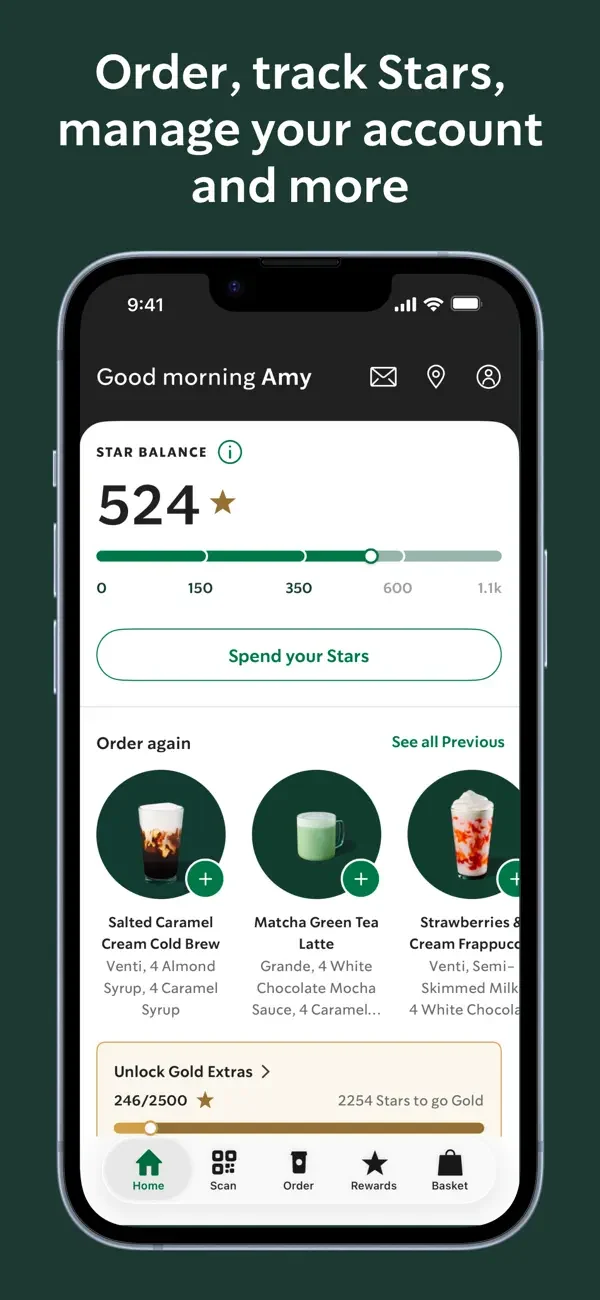
Why visible progress deserves attention
In a café field study, Kivetz, Urminsky and Zheng found that purchases became more frequent as participants approached their reward. Their experiments also examined how perceived progress affected completion. The original research gives a reason to make progress understandable; it does not establish a guaranteed uplift for your own scheme.
The practical test is straightforward: can customers see what they have earned and what remains? For points, make the next meaningful reward understandable instead of displaying an unexplained number.
Give staff a complete operating rule
A useful explanation might be: “Save our card, show it for eligible purchases and collect eight stamps for the listed reward.” That is the customer sentence. Staff also need the operational detail.
Decide who can award progress, who can approve corrections, what evidence a correction needs, and how staff verify a reward has been redeemed. Make the scanner available on every relevant shift.
Include difficult cases in training: a split payment, a refund, a group order, a customer with no card available and a request to combine two offers.
Show the relationship between progress and reward
Starbucks’ published reward screen connects its balance with redemption choices. Customers should be able to understand what progress is worth before committing to the programme.
Official imagery captured 28 October 2026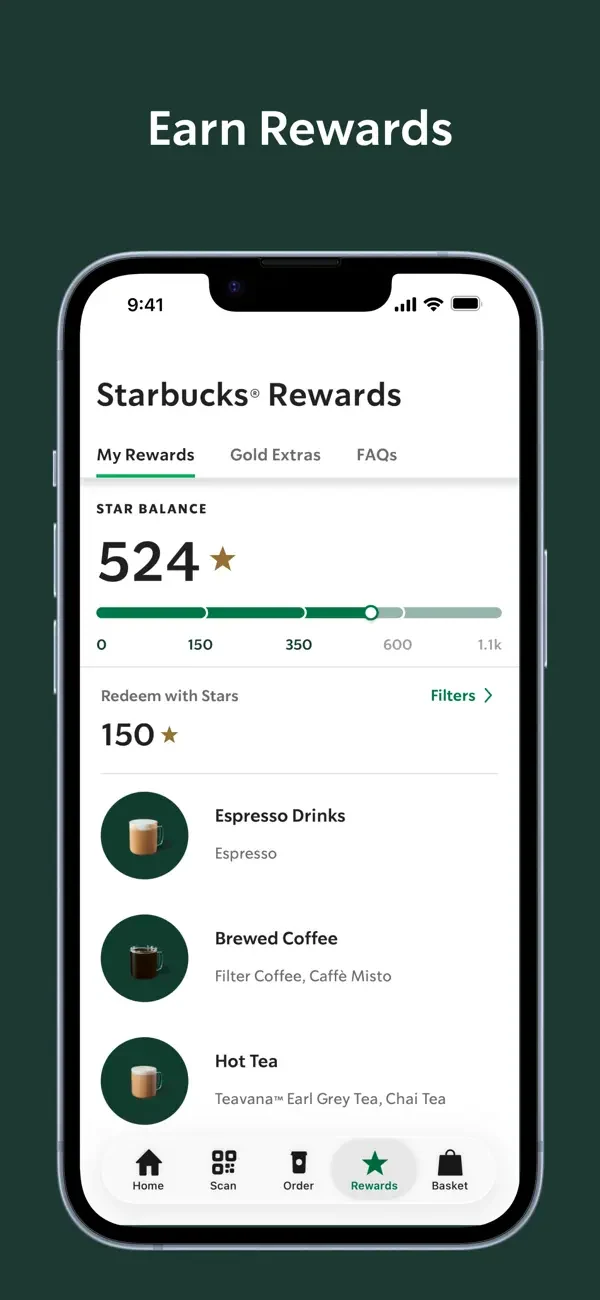
Check the economics before advertising
| Item | Record before launch |
|---|---|
| Reward | Exact item, credit or service benefit |
| Direct delivery cost | Product, consumables and relevant labour |
| Capacity cost | Whether delivery displaces a saleable appointment or item |
| Earning requirement | Qualifying purchases needed |
| Programme costs | Software, administration and relevant add-ons |
| Review method | How additional behaviour and costs will be assessed |
Use realistic costs rather than the reward’s menu price alone. A £10 customer-facing benefit does not necessarily cost £10 to deliver, and a low-material-cost service can still use valuable appointment time.
Our six-part design checklist
This is MSTRMND’s practical editorial checklist, not a universal industry model.
- Objective: one defined behaviour and customer group.
- Reward: a specific benefit worth understanding.
- Progress: earning rules customers can follow.
- Experience: a tested signup, wallet and checkout journey.
- Operations: consistent staff actions and exceptions.
- Review: a baseline, appropriate timeframe and cost view.
Use it to find the weak point before launch. You do not need to invent a separate programme for every acronym or loyalty framework.
Where MSTRMND and Flann fit
MSTRMND supplies the digital card and loyalty management layer. It cannot choose your commercial objective or decide what reward your customers will value without your input.
Flann can be added for broader AI-assisted business workflows, including marketing and customer conversations across connected tools. Treat that as an operations decision after the loyalty programme itself makes sense.
Pro tip. Before launch, ask two staff members to process the same three example purchases independently. Different awards mean the rules or training need work.
Frequently asked questions
What are the most important features of a good loyalty scheme?
A clear objective, worthwhile reward, understandable rules, consistent delivery and a sensible review process. Attractive card design supports those features but does not replace them.
How many visits should a reward require?
There is no universal number. Compare the customer’s normal return interval, reward appeal and delivery cost. Test the proposed journey before committing.
Should rewards expire?
Only set a validity period you can explain and administer fairly. Consider the purchase cycle and make the terms visible before customers earn value.
What are the three R’s or four C’s of loyalty?
Different writers use different frameworks. For practical programme design, evaluate the actual offer and process rather than assuming one acronym is an accepted standard.
Can a simple scheme be better than a complex one?
Yes, when the simpler scheme meets the objective and staff can run it consistently. Extra tiers and conversions need a clear purpose.
Does a loyalty scheme replace good service?
No. A reward does not remove the reasons a customer might stop visiting, such as poor service, inconvenient booking or inconsistent quality.
When should I change the programme?
Change it when a defined review shows a problem, then communicate the transition and treatment of existing progress. Avoid frequent unannounced changes.
Turn the checklist into a working card
Book a demonstration or continue with how to set up a loyalty scheme.